
Siding Over Siding: What It Hides, What It Can Void, and When It's Allowed
Two siding quotes for the same house can differ by a wide margin, and the gap often comes from one decision: whether the old siding comes off. One installer tears the walls down to the sheathing. Another hangs new panels over what's already there. Going over the old siding saves labor and disposal, and it's sometimes allowed by the installation instructions. It also covers up the one chance to see what's happening inside your walls.
Emmendorfer Exteriors tears off to the sheathing as our standard on Franklin County re-sides. This article explains what the industry instructions actually say about over-siding, what it can hide, the extra questions older homes raise, and when going over might be reasonable.
What the installation instructions say
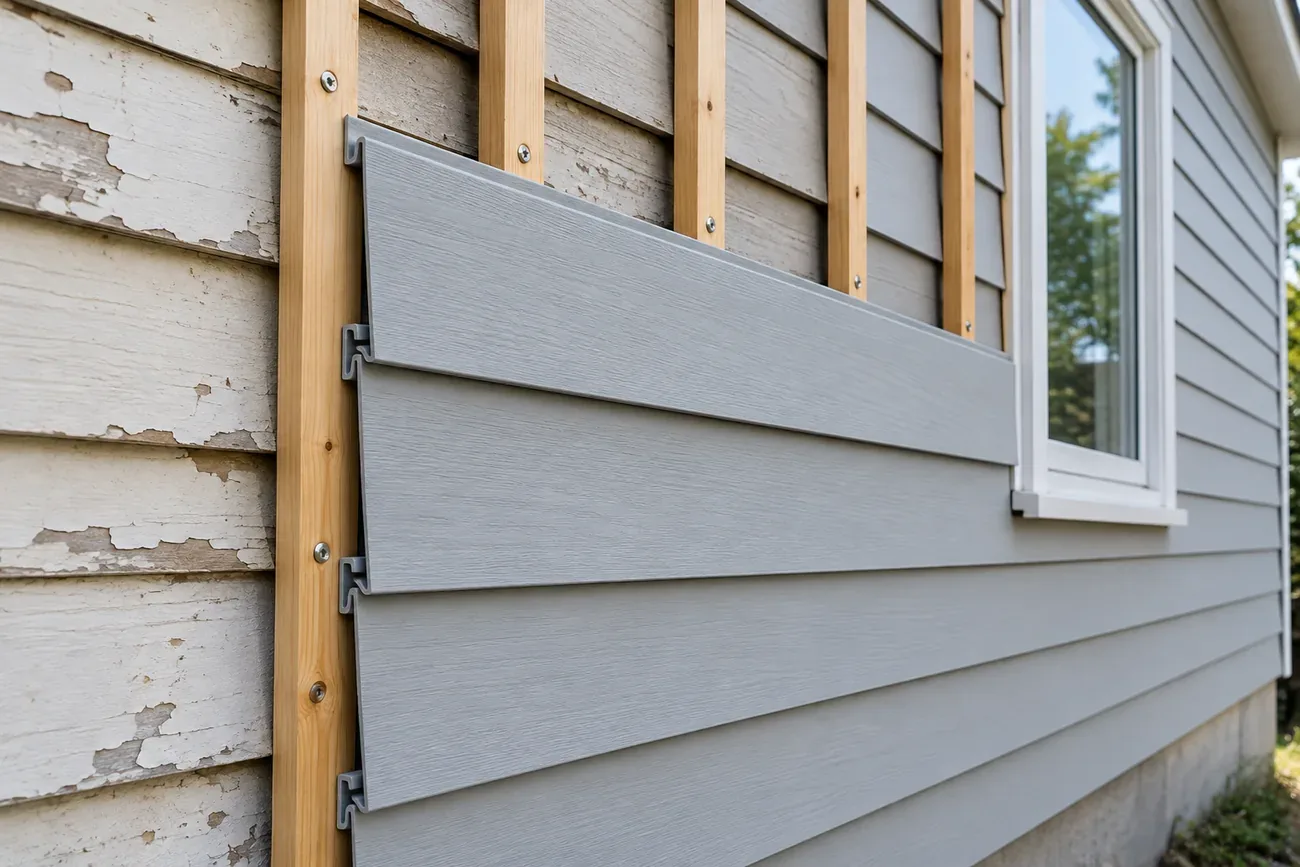
Over-siding isn't automatically against the rules. The Vinyl Siding Institute's installation manual includes directions for re-siding over existing walls. It tells installers to nail down loose boards, replace rotten ones, and never install vinyl over rotting wood. It also says uneven original siding may need furring strips or removal so the new panels lie on a smooth, continuous surface.
The same manual stresses that vinyl siding is a cladding, not a water-resistive barrier. It's designed to go over a barrier system that includes a continuous water-resistive layer and flashing integrated around windows, doors, and other openings. That's the part over-siding makes hardest to get right.
Each manufacturer's own instructions set the specific conditions for its product. Installing outside those instructions can leave damage that results from the installation without warranty coverage. LP, for example, says an installation error voids coverage for the damage it causes rather than the entire warranty, so the risk still matters even when the warranty survives.
What going over the old siding can hide
The old siding is a cover. Leaving it in place means trusting that nothing behind it needs attention, and on a house that has been through decades of Missouri weather, these are the usual problems:
- Rotted sheathing and sill plates near the foundation and below windows.
- Window and door openings that were never flashed, or were flashed badly, which can't be corrected without opening the wall.
- A missing or failed water-resistive barrier behind the old siding.
- Insect damage and old leak paths that stay active under the new panels.
- Moisture trapped between two layers of cladding.
When we pull siding on an older home, the wall tells us what needs fixing before anything new goes on. Our siding installation process replaces rotten sheathing and trim, then adds house wrap and flashing before the first panel goes up.
Older homes: lead paint and asbestos siding
Homes built before 1978 add two questions that affect the tear-off decision.
The first is lead paint. Under the EPA's Renovation, Repair and Painting rule, paid work that disturbs 20 square feet or more of painted exterior surface on a pre-1978 home must be done by a certified firm using lead-safe work practices. Pulling painted wood siding or trim easily crosses that line. The EPA's guidance for homeowners recommends hiring a lead-safe certified contractor and explains what to expect.
The second is asbestos-cement siding, the hard, shingle-shaped panels found on some mid-century homes. The VSI manual calls asbestos siding a regulated material and tells installers to contact the environmental agency or local building official before residing over it. The Missouri Department of Natural Resources says its asbestos rules apply to commercial buildings and some residential structures, and most single-family homes are exempt. Breaking or removing the material is still a hazard. Covering intact asbestos siding can be a reasonable choice, but have it tested and get advice before deciding.
Tear-off vs. over-siding at a glance
| Tear-off | Over-siding | |
|---|---|---|
| Wall inspection | Every section is visible | Only what shows at the edges |
| Sheathing and rot repair | Done before new siding | Limited to what's found |
| Window and door flashing | Can be corrected | Hard to integrate properly |
| Water-resistive barrier | New, continuous layer | Depends on what's underneath |
| Wall thickness | Unchanged | Thicker, so window and door trim may need building out |
| Labor and disposal | More | Less |
| Lead or asbestos disturbance | Requires the right precautions | May disturb less material |
When over-siding can be reasonable
Going over existing siding can make sense in a few cases: when the old siding is flat, sound, and dry wood; when intact asbestos-cement siding is better left undisturbed; or when a historic review favors keeping original material in place. The VSI manual recommends that historic buildings be checked for moisture, insects, and structural problems before any re-siding, whichever approach is chosen.
If an installer proposes going over, ask these questions before you sign:
- How will you confirm there's no rot behind the old siding?
- How will you flash the windows and doors, and where will the water-resistive barrier go?
- What will you use to create a flat surface, and how will you extend the window and door trim?
- Does the manufacturer's installation guide allow this over my existing siding, and can I see that section?
- Is my home pre-1978, and are you an EPA lead-safe certified firm?
For help choosing the new material itself, see our comparison of LP SmartSide, vinyl, and fiber cement for Missouri homes.
Frequently asked questions
Does installing vinyl over old siding void the warranty?
Not automatically. Industry installation instructions allow re-siding over sound existing siding with a flat surface and a proper water-resistive barrier. Installing outside the manufacturer's instructions can leave related damage without coverage, so ask to see the section that covers your wall.
Can new siding go over asbestos siding?
Sometimes, and covering intact material can avoid disturbing it. The Vinyl Siding Institute's manual calls asbestos siding regulated and advises contacting the environmental agency or local building official first. Have the siding tested before any work starts.
How do I know if my siding has lead paint?
If your home was built before 1978, assume painted siding and trim may contain lead until testing shows otherwise. The EPA recognizes certain lead test kits, and certified inspectors can test for you.
Does over-siding add insulation?
Some installers add foam underlayment over the old siding to flatten the wall, which adds a modest amount of insulation. It doesn't replace a water-resistive barrier or proper flashing around openings.
Is siding over siding the same as a roof layover?
The idea is similar. Both cover the old layer instead of removing it, saving labor while hiding what's underneath. Our article on roof tear-off vs. layover explains the roofing side.
Deciding what comes off
Over-siding is allowed in some cases, but it trades a lower price for a wall nobody has inspected. On most Franklin County homes, tearing off is the only way to find rot, fix flashing, and install a continuous barrier before new siding goes up. Emmendorfer Exteriors pulls a section of your siding during the estimate, shows you what's behind it, and names the brand and color in writing. We install siding in Union, Washington, Pacific, St. Clair, Sullivan, Villa Ridge, and New Haven. Request a free siding estimate to see what your walls are hiding.
A real Emmendorfer walks your actual roof and gives you a firm written price. Family-owned since 1990.