
Standing Seam vs. Exposed-Fastener Metal Roofing for Franklin County Homes
Drive any county road between Union and Sullivan and you'll see plenty of metal roofs on barns, shops, and machine sheds. Most of them are ribbed or corrugated panels screwed straight through the face. Ask for a quote on metal for your house, and the price for standing seam is noticeably higher. The difference comes down to how the panels are fastened, and that one detail decides how the roof handles Missouri's temperature swings and how much upkeep it needs.
Emmendorfer Exteriors installs both. We put standing seam on homes and use exposed-fastener panels on barns, shops, garages, and outbuildings where they fit the building and the budget. Here's how the two compare and why we recommend each where we do.
What separates the two systems
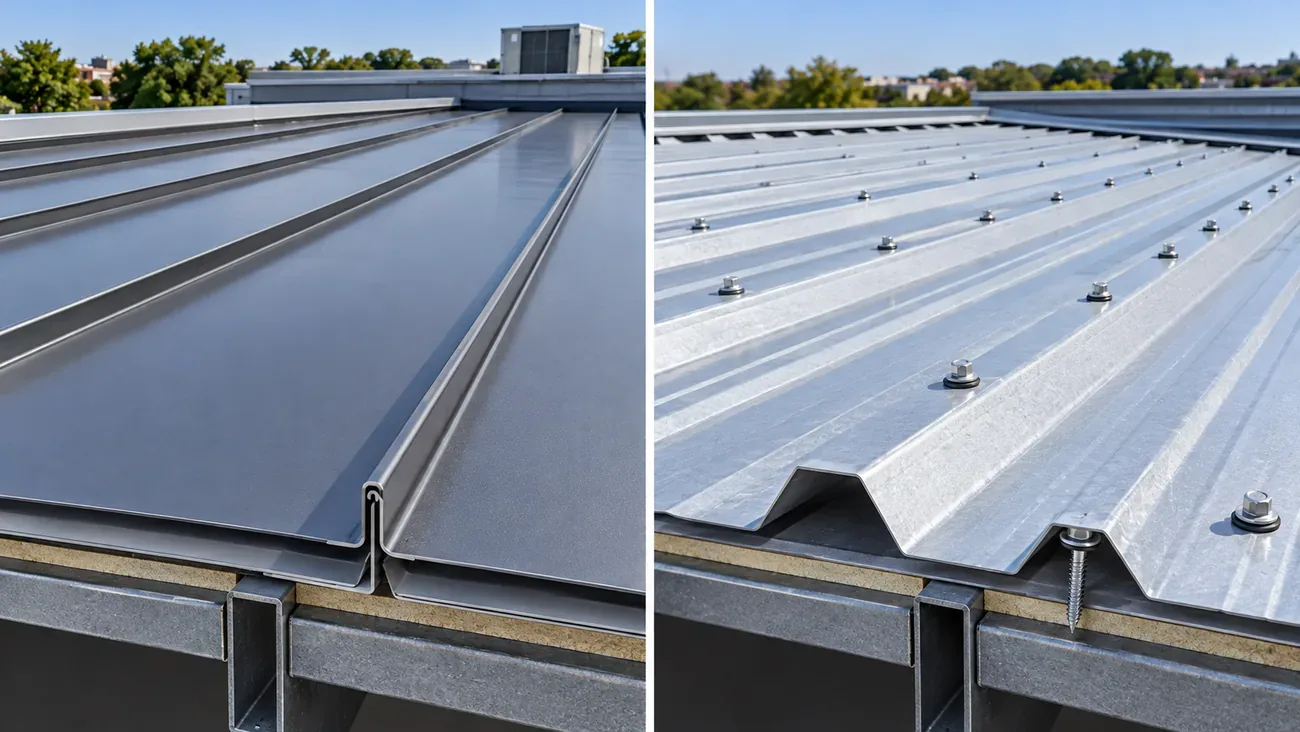
A standing-seam roof uses panels joined at raised, interlocking seams and held down by clips or a fastening flange hidden under the panel. No screw passes through the surface that sheds water.
An exposed-fastener roof, sometimes called screw-down or through-fastened, uses ribbed or corrugated panels such as R-panel or 5V. The panels overlap at the edges and are screwed through the face into the deck or purlins. Each screw has a rubber sealing washer under its head to keep water out of the hole.
| Standing seam | Exposed fastener | |
|---|---|---|
| Fasteners | Hidden clips or fastening flange | Screws through the panel face |
| Thermal movement | Panels slide on clips | Screws hold panels in place |
| Holes in the weather surface | None in the panel field | Hundreds, each sealed by a washer |
| Upkeep | Low; check flashing and penetrations | Periodic screw and washer checks |
| Code minimum slope (IRC R905.10.2) | 1/4 inch per foot | 3 inches per foot, or 1/2 inch with lap sealant |
| Up-front cost | Higher | Lower |
| Where we install it | Homes, porches, low-slope sections | Barns, shops, garages, outbuildings |
Why fasteners matter in a Missouri climate
Steel grows and shrinks with temperature. A south-facing slope in July and the same slope on a January night are very different sizes, and Franklin County runs through that cycle every year.
Standing seam is built for that movement. The Metal Construction Association's best practices guide for standing seam roof clips describes how clips let panels move with thermal cycling while staying attached to the structure.
On a screw-down roof, the screws pin the panel. As the metal moves, it works against each fastener. Over the years that can loosen screws, enlarge the holes, and age the rubber washers, which already sit exposed to sun and weather. Our metal roofing page notes the same trade-off: exposed-fastener panels cost less but give up some longevity, partly because of fasteners that back out over time.
Low slopes and porches
The International Residential Code sets minimum slopes for metal panel roofs in Section R905.10.2. Standing-seam systems can go as low as one quarter inch per foot. Lapped panels without applied sealant need at least 3 inches per foot, or one half inch per foot when lap sealant is applied according to the manufacturer. Manufacturers can require steeper minimums for specific profiles, and their instructions govern.
That's why standing seam is the usual answer for low porches and additions tied into a steeper main roof. For flat or nearly flat areas, a membrane system is often the better fit, as our low-slope roofing page explains.
Where exposed-fastener panels make sense
Screw-down metal is a good roof for the right building. It installs faster, costs less, and works well on open-framed structures where a drip now and then won't damage finished ceilings. A pole barn, a detached shop, a machine shed, or a garage is a sensible place for it. Periodic fastener checks are easier to accept on a building like that than over a bedroom.
Why we recommend standing seam for homes
On a house, the math changes. Here's what tips it toward standing seam:
- Every exposed screw is a potential leak point above finished ceilings and insulation, and a slow leak can soak decking for a long time before it shows.
- Standing seam needs far less routine maintenance, which matters for owners who chose metal so they wouldn't have to climb a ladder again.
- Homes have chimneys, valleys, sidewalls, and dormers, and standing seam allows cleaner custom flashing at each one.
- We install it over a solid deck and high-temperature underlayment, so the whole roof assembly is built for the long life metal promises.
If a homeowner wants metal but the budget points to exposed fastener, we'll say so plainly and compare it against a quality shingle. Our metal vs. shingle guide covers that decision.
Caring for an exposed-fastener roof
If you already have screw-down metal on a shop or barn, a little attention goes a long way:
- Look it over after major storms and on a regular schedule.
- Check for screws that have backed out, washers that are cracked or hardened, and rust stains around fastener heads.
- Inspect end laps, ridge closures, and pipe boots, where leaks also start.
- Replace failed screws with ones specified by the panel manufacturer, and don't overdrive them, which crushes the washer.
Hail can dent either system, and many policies treat dents differently from leaks. Our article on metal roof hail damage and cosmetic exclusions explains what to check with your agent.
Frequently asked questions
Is exposed-fastener metal roofing OK on a house?
It can be done, and some homes have it. The trade-off is more potential leak points and more maintenance over the roof's life. For a home, we recommend standing seam. For barns, shops, and garages, exposed fastener is often the practical choice.
Can an exposed-fastener roof be converted to standing seam?
Not by modifying the existing panels. Switching systems means removing the old panels and installing a new standing-seam roof, usually over solid decking and new underlayment.
How often should screws on a metal roof be checked?
There's no single schedule. Look after major storms and as part of a regular roof inspection, checking for loose screws, failed washers, and rust stains. Catching a failed fastener early is far cheaper than repairing a soaked deck.
Can a metal roof go over my old shingles?
We don't install metal over an old roof. We tear off to the deck and replace soft sheathing first, because a wavy or rotten deck shows through metal panels and hides problems that should be fixed now.
Does standing seam cost more than exposed fastener?
Yes. Standing seam takes more material and labor, so it costs more up front. Our metal roofing page lists current ranges for both, and the roof cost guide covers what moves the price on any roof.
Picking the right metal for the building
Exposed-fastener panels belong on the shop and the barn. Standing seam belongs on the house, where hidden fasteners, fewer leak points, and room for thermal movement justify the higher price. Emmendorfer Exteriors installs both and names the panel, gauge, and color on the written estimate.
We install metal roofing in Union, Washington, Pacific, St. Clair, Sullivan, Villa Ridge, and New Haven.
Request a free metal roofing estimate for your home or outbuilding.
A real Emmendorfer walks your actual roof and gives you a firm written price. Family-owned since 1990.